

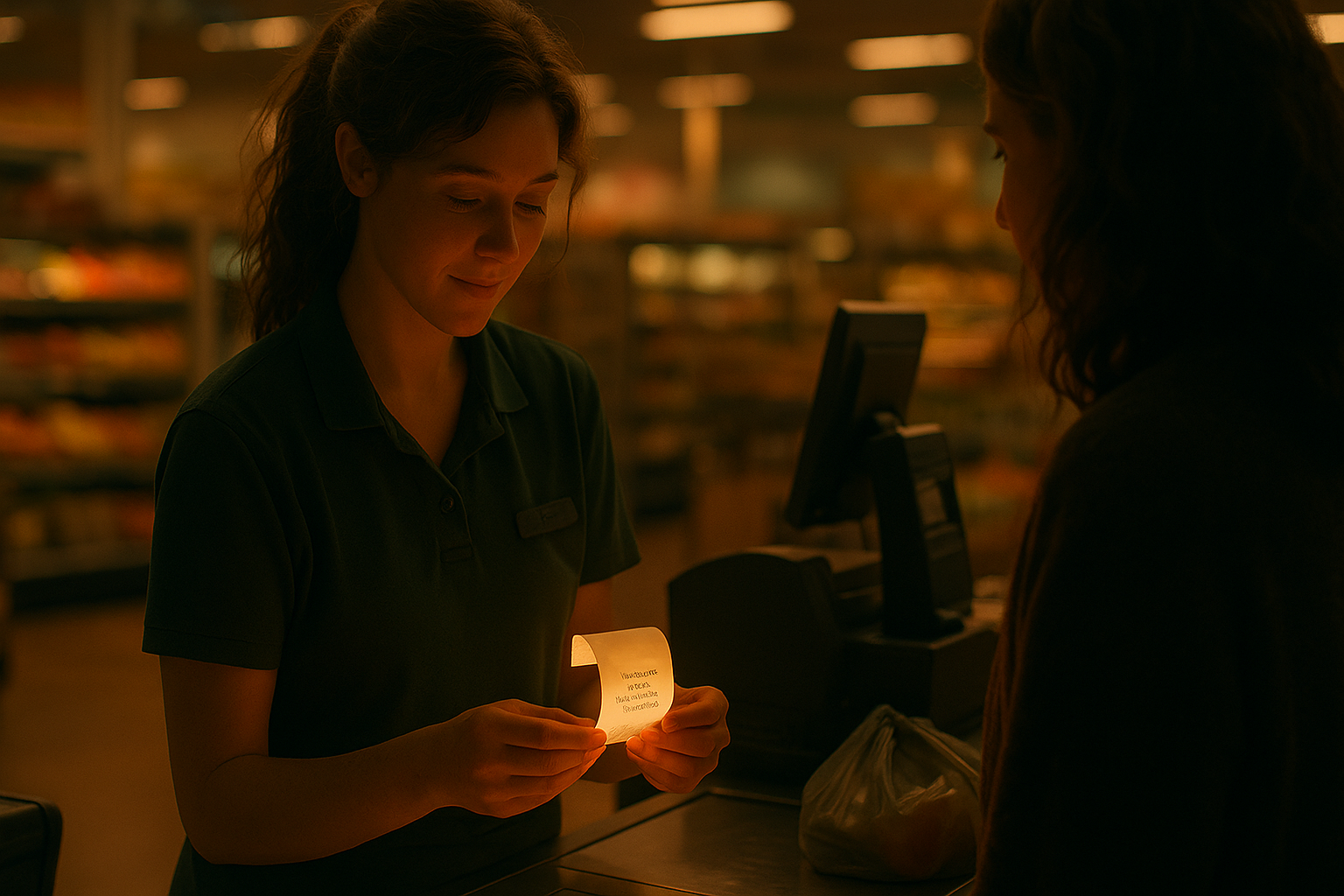
By the time the first miracle slid out of Register Three, the store was almost empty.
It was the kind of late afternoon that always made the supermarket feel like a waiting room for the rest of the day: sunlight slanting in weakly through the high dusty windows, the air-conditioning too cold for early autumn, the soft, endless hum of the refrigerators like someone humming under their breath. The aisles were sparsely populated with people moving slowly and precisely, as if they had been wound down. The big rush of the lunch crowd was gone, the after-work surge hadn’t started yet, and between those tides sat Ava, leaning on her lane, chin propped on her hand, watching the red digital numbers of her register do nothing at all.
She liked it here, in the pockets when time felt soft.
“Three is clear,” she called, out of habit rather than necessity. No one was waiting. The only people visible from her lane were Mrs. Denov from the bakery section, fussing with a display of bread rolls, and a teenager in a navy hoodie wandering aisle six with a basket, reading labels like they were exam questions.
Ava brushed a stray curl out of her face and tapped a key on the register, just for the comfort of a sound. She had been here almost three years, ever since she came back to town and quietly interviewed with a manager who didn’t ask too many questions. The supermarket—BrightMart, though no one actually called it that—hummed on without needing her history. It needed someone who would clock in, ring up the oranges and frozen pizzas, say “Have a nice day” to people who wouldn’t remember her face. She could be useful and invisible at the same time. That had felt like safety.
The bell over the sliding doors chimed, even though it didn’t have to; they slid open with their fake cheery sigh, and Nora walked in.
Ava felt it before she fully saw her—something in the way Nora always entered a room like she was half inside a story only she could hear. She was small, with a dark braid and the habit of wearing sweaters that were a little too big, sleeves that slid down over her fingers. She worked at the florist’s down the street and came in most days at around this time to buy odd combinations of things: tea, lemons, ginger, a bag of potting soil, a jar of olives, a cheap paperback from the spinner by the registers. Ava had never asked; it wasn’t her business. But she’d started to look for the shape of Nora’s silhouette out of the corner of her eye, listening for the sound of her footsteps—light, precise—on the scuffed floor.
Today Nora’s basket was half full. Cereal. A carton of eggs. A bag of carrots with a tear in one corner, chosen from the discount bin. She joined Ava’s lane even though the self-checkouts were open and glowing like empty stages.
“Hey,” Nora said, placing her items on the belt. Her smile was small but real. “How’s your day?”
“Waiting to see if anything interesting happens,” Ava replied, scanning the cereal. “So far it’s a thrilling lineup of carrots and coupons.”
Nora laughed, the sound bright as glass. “Maybe you’ll get a celebrity later. Someone who used to be on a cooking show in 1997.”
“I’d settle for someone who doesn’t argue about the price of avocados,” Ava said.
She moved habitually, fingers dancing over buttons, lifting items, the beep-beep a metronome. In the quiet, she was acutely aware of Nora’s presence, of the faint smell of flowers clinging to her—green stems, wet earth, something sharp like eucalyptus.
“Anything else for you?” Ava asked when she’d scanned the last item.
“No, that’s—” Nora started, then hesitated, fingers tightening around the strap of her bag. “Actually, do you… um. Never mind.”
“What?” Ava looked up. Nora’s eyes, a warm brown, darted away and then back.
“Do you ever feel like… like you’re stuck between scenes?” she asked, sounding embarrassed. “Like this isn’t the part of your life you’re supposed to remember later, but you’re in it anyway.”
Ava blinked, the question landing somewhere deeper than she expected. The registers around them hummed quietly. A distant child was negotiating with a parent over a candy bar. The fluorescent lights buzzed.
“All the time,” Ava said, before she could decide to say something safer.
Nora’s shoulders dropped in relief. “Oh. Okay. Just checking I’m not the only weirdo.”
“You’re not alone,” Ava said. “I live in the deleted scenes.”
Nora smiled, her expression turning soft in a way that made Ava’s chest ache. “Then I’m glad we’re in the same cut.”
The register screen flashed the total, and Ava reached instinctively for the receipt button. The printer whirred and spat out a thin strip of white curling like a ribbon into her hand.
Only it wasn’t just numbers.
Ava’s eyes caught on the printed ink. It wasn’t formatted the way it should be. Beneath the list of purchased items and savings, the fading black letters continued in a thin column of text, smaller than the rest, as if someone had whispered onto the paper.
You are not stuck. You are in the middle.
Her heartbeat stumbled.
She stared at the words, at the neat, tiny font that was exactly the same as the prices above, as the store policy at the bottom. No handwriting. No smudge. No sign that anyone had tampered with the machine.
“Everything okay?” Nora asked, tilting her head.
Ava swallowed. “Yeah, I just… the printer’s being weird.”
She almost tore the receipt in half; almost crumpled it and said nothing. But something in the quiet of the store held its breath. Slowly, she folded the slip and handed it over, cool against her fingers.
“Here you go.”
“Thanks,” Nora said, taking it. She glanced at the total, then frowned as her eyes moved lower. “Huh.”
The silence stretched. Nora’s gaze traced the tiny line of words. Ava watched her, suddenly desperate to know how she would react.
Nora looked up, eyes bright and unsettled. “Did you… write this?”
Ava shook her head, feeling absurd. “No. The register just… printed it.”
Nora read it again. “‘You are not stuck. You are in the middle.’” She exhaled in a small rush. “That’s… oddly specific.”
“Must be a glitch or something,” Ava said, though the words tasted wrong. Computers didn’t develop poetic tendencies.
Nora folded the receipt carefully and tucked it into her wallet like something fragile. When she looked at Ava again, there was a question in her gaze, but she didn’t ask it.
“Thank you,” she said instead. Her voice sounded different—softer, almost reverent. “For the groceries, and for… whatever that was.”
Ava watched her go, the bell above the doors chiming faintly again as Nora walked back out into the pale afternoon light. The automatic doors sighed closed.
Her register blinked back to its usual blank, green-tinted screen. The world resumed. The teenager in aisle six finally moved toward the dairy section. Mrs. Denov reorganized the bread for the third time.
A glitch, she told herself. Maybe a prank. Maybe the printer queue got crossed with some artsy flyer the marketing team had made. But an unease lingered, like the faint perfume of Nora’s flowers.
It was just one line. One coincidence.
Until the next one.
Three customers later, an elderly man placed a single can of soup on her belt. He came in twice a week, always alone, always with just enough for one person to eat in one sitting. His name, she knew from his loyalty card, was Tomas. Today he moved slower than usual, his hands shaking slightly as he fished for his wallet.
“Cold out there?” Ava asked, scanning the soup.
“Colder in here,” he muttered, but there was no malice in it. Just a bone-deep weariness.
The receipt printed out with its usual mechanical sound. Ava’s hand hovered before taking it, dread and curiosity tangling in her ribs. She lifted it and felt her skin prickle.
Again, beneath the total, the numbers melted into words.
Call her. She is waiting to forgive you.
Ava’s mouth went dry.
She nearly spoke—nearly asked him if there was someone he’d been meaning to call, if there was a daughter or a sister or a friend across town. But who was she to open that door? To point out a stranger’s ghosts?
She hesitated too long. Tomas held out his hand for the receipt, his fingers slightly curled.
“Your change,” she murmured, passing it to him.
He unfolded it, lips pursing as he checked the amount. His eyes snagged on the bottom line. The color seemed to drain from his face.
He read it once. Twice. Then he looked up at Ava, his eyes unexpectedly sharp.
“Is this some kind of joke?” His voice trembled, more with something like fear than anger.
“No,” Ava said quickly. “I swear, it just printed that. I don’t know how.”
Tomas stared at her, searching for the lie. He must have found none, because his gaze dropped back to the paper. His thumb stroked the words as if they were carved there.
“Forty-three years,” he whispered, so quietly Ava almost didn’t hear it. “Forty-three years and you pick today.”
It wasn’t clear who he was talking to.
He folded the receipt very precisely, corners aligned, and slipped it into his breast pocket. When he looked up again, his eyes were damp.
“Thank you,” he said hoarsely. “Whatever… whoever… thank you.”
He left without his change.
Ava stood at her register with her hands braced on the counter, the fluorescent lights too bright, the hum of the fridges now a chorus in her skull. She looked at the printer like it might sprout a mouth and explain itself.
Nothing happened for the next ten customers. The receipts were mundane: totals, loyalty points, survey links no one ever used. By the time her break came, she’d almost convinced herself she’d imagined it, or misread it, or fallen into one of those small strange pockets of afternoon where reality grew thin and threadbare.
In the cramped employee lounge, with its peeling motivational posters and humming vending machine, she found her locker and opened it. On the upper shelf sat a small cardboard box, taped shut, the edges fuzzed with wear. It had been there all three years she’d worked at BrightMart, untouched. Inside were papers she had not been ready to sort through: her mother’s handwriting on hospice forms, appointment cards, a photograph of them both on the last day she’d been well enough to leave bed.
You are not stuck. You are in the middle.
She wondered what it would take to believe that.
Word spread slowly.
First, it was just Nora, returning a week later with a bag of oranges and a look in her eyes like someone holding their breath.
“I’ve been carrying it around,” she admitted as Ava scanned her items. “The receipt. I keep reading it on the bus, like it might change.”
“Has it?” Ava asked, not entirely joking.
Nora smiled crookedly. “No. But I have. I… I signed up for a night class. Creative writing. It felt like something a person in the middle might do, not someone stuck.”
A warmth bloomed beneath Ava’s ribs. “That’s—”
The printer whirred. Ava grabbed for the receipt, almost unsteady. The words had become a kind of cliff now, she realized. She was always stepping off, not sure if there’d be ground or sky.
This time, the message was different, but no less precise.
Ask her to get coffee. You’re allowed.
The breath left her in a startled laugh that sounded wrong in her own ears.
“What?” Nora asked, eyes wide.
Ava hesitated, then turned the paper so Nora could see. Nora read, blinked, and color rose under her cheeks.
“Oh,” she said softly.
Her gaze flicked up, uninterpretable. The store seemed to hush around them, every sound receding. A woman in aisle three compared brands of tomato sauce. A child in a cart swung his legs, humming to himself. The world kept spinning, oblivious, and here, in the narrow slice of space by Register Three, time tightened like a held breath.
“Is it… messing with us?” Nora asked, but she didn’t sound entirely displeased.
“I don’t know what it’s doing,” Ava admitted. Her heart pounded. “Most of them are… helpful. I think.”
Nora traced the bottom of the receipt with her thumb. “Are you going to listen to it?”
Ava opened her mouth, closed it. The old familiar urge—to step back, to stay in the background, to not risk being seen—rose like a tide. But she thought of Nora’s writing class, of Tomas walking out of the store with his shoulders a little straighter, of the box in her locker she couldn’t bring herself to open.
Maybe small miracles were more like nudges than fireworks.
“Are you free after your shift?” she asked, the words trembling but intact. “There’s a little place two blocks over. They have terrible coffee and great pie.”
Nora’s smile broke over her face like something that had been trying to get out for a long time. “I love terrible coffee,” she said. “I’ll wait.”
They looked at each other, both slightly dazed, and then the moment dissolved back into the mundane—bags packed, cards swiped, “Have a nice day” spoken as if the world hadn’t just tilted by a degree.
Behind them, the receipt printer sat quiet, as innocent as any machine.
Soon, the regulars began requesting her lane.
They came with their shopping lists and quiet crises, their invisible weights and unsaid hopes. A woman clutching a pregnancy test and a loaf of bread. A kid with a backpack too heavy for his thin shoulders, buying instant noodles and a spiral notebook. A man in a paint-stained jacket picking out a single birthday card and nothing else.
Sometimes, the receipts were just receipts.
Sometimes, they said things like:
You can rest. No one will leave if you stop.
Today is not the ending you’re afraid of.
Ask for help before the dishes become mountains.
Not every customer noticed. Some shrugged and smiled and slid the slip into their bag without looking. Some read, paled, and clutched it hard enough to wrinkle the paper. Once, a teenager saw their message—You are not as alone as you think you are—and burst into tears so sudden and fierce that Ava stepped around the counter and let them cry into her shoulder while the cold food waited patiently in its plastic bags.
Management never found out.
Or rather, the store manager, Mr. Fisk, did see one at random when he ran his own purchases through Ava’s lane on a Thursday, buying a sad frozen lasagna and a tiny cactus in a pot chipped on one side. His receipt read: You are kinder than you let yourself be. He stared at it for a long time, his jaw working, then folded it once and slid it into his pocket without a word.
After that, he didn’t ask any questions about the increasing number of people in Ava’s line, or the way she sometimes took an extra thirty seconds per customer.
A quiet understanding settled over the store. The miracles belonged to Register Three. If you needed something you didn’t know how to ask for, you shopped there.
On a rainy Tuesday that smelled of wet umbrellas and overripe grapes, Ava finally opened the box in her locker.
The decision came without fanfare. She had finished her shift, cheeks still warm from laughing with Nora about lemon tarts and terrible poetry, and was halfway into her coat when something inside her unclenched. Her fingers reached up of their own accord, bringing down the cardboard box with its taped edges.
She sat on the bench, the hum of the vending machine behind her, and peeled the tape away.
Inside were papers, as she knew there would be. Forms and pamphlets and a brochure with a picture of a woman walking along a beach, promising “Support in Your Time of Transition.” There was the photograph she wanted and didn’t want to see: her mother in a striped shirt, squinting at the camera, hair wild from the lake wind, one arm thrown around Ava’s shoulders, both of them laughing.
Beneath the stack of papers, there was something she didn’t remember leaving there.
A crumpled grocery receipt.
She lifted it, the paper gone soft with age, ink faded. The date at the top was two years old. Her eyes skimmed down—milk, bread, soup, oranges—and caught on the bottom where the paper had wrinkled.
No message.
Just the generic “Thank you for shopping at BrightMart!”
She nearly laughed, a little hysterical sound. Why had she kept it? Why had she put it in the box with everything else she wasn’t ready to face?
And then, as she smoothed it, the light in the room flickered—not in the dramatic way of movies, but in a small, almost shy pulse. The fluorescent bulb overhead buzzed louder for a second, then settled. On the receipt, the blank space beneath the total shimmered, as if moisture were drying there.
Words appeared, slow and deliberate, like ink blooming into fabric.
You did enough. She knew.
Tears came so fast they stung. She pressed her lips together, chest heaving, one hand closing around the paper until the edges bit into her skin.
“I didn’t,” she whispered, throat tight. “I left. I couldn’t stay. I couldn’t watch.”
You did enough. She knew.
A tiny, impossible mercy, printed in tiny, impossible letters.
Ava bent forward, shoulders shaking, and let herself cry in the beige, humming employee lounge, the smell of coffee and vending machine snacks thick in the air. The box sat open beside her, the past no longer an unbroken wall but something with a hairline crack running through it, letting in light.
When she finally stood, she folded the receipt carefully and put it in her wallet, next to the one she’d managed to steal from Nora’s pile the night the machine told her to ask for coffee.
The miracles didn’t solve everything.
Tomas called his sister and they argued for an hour, voices raised and old grievances bared, but by the end of the week, he was buying ingredients for two at the supermarket instead of one.
The teenager with the heavy backpack didn’t suddenly become confident, but they did show Ava the sketchbook they’d hidden between textbooks, and Ava, heart pounding, told them it was beautiful and meant it.
Nora’s writing class did not transform her into a best-selling author overnight, but she started leaving little folded poems in flower bouquets on bad-weather days, and customers came back to say those scraps of words had made the morning less gray.
Ava and Nora’s coffee dates were awkward and sweet, full of hovering questions and shared silences. They talked about books and customers and the small ways the city disappointed and delighted them. They did not define anything quickly. The miracle machine could nudge, but it could not live each difficult, tender moment for them.
And still, every day, Register Three hummed faithfully, printing totals and taxes and, now and then, the smallest of miracles in twelve-point font.
Sometimes, on slow afternoons when the light slanted in just so and the hum of the fridges felt almost like a lullaby, Ava would glance at the printer and wonder who—or what—was on the other side. A ghost. An algorithm gone strange. A tired universe trying to apologize, one receipt at a time.
Once, in a moment of quiet audacity, she printed a blank slip for herself with no purchase at all, hand hovering as it emerged. She stared at the empty space, heart thudding.
Slowly, letters formed, each one a soft insistence.
You are allowed to be happy, too.
She tucked that one into her pocket without showing anyone.
Outside, the town went on. The buses ran late. The florist’s bell chimed when Nora went in and out. Leaves gathered in the gutters. Somewhere, someone decided to forgive. Somewhere else, someone decided to stay.
And in the fluorescent-lit supermarket on the corner, where the afternoons sometimes wavered and time felt like it might be gently edited, a cashier at Register Three rang up milk and bread and oranges, and placed into strangers’ hands the smallest, quietest slips of magic.